- News and Stories
- Blog post
- Safety Net
Getting Clear Answers about Income and Household Composition

To receive a government benefit, clients usually have to answer questions about their income and household composition. While these might seem like simple things to report, the reality is often complicated. Applicants might have income from multiple sources of part-time work with or without forms like paystubs, they may not know they have to report unearned income like child support, or they could have jobs that start and stop at irregular intervals. All this can make it tricky to answer a question like, “How much money do you make each month?” Similarly, determining who is in your household becomes complicated if the person applying has part-time custody of their children, or takes care of older adults.
Asking about income and household composition in unclear or complicated ways can lead to errors—delaying benefits, frustrating clients, and making more work for caseworkers. But it doesn’t have to be this way.
Over the past 15 years, Code for America has helped governments design services to improve their efficiency and effectiveness, and our research has given us an understanding of best practices for asking about income and household composition in online applications. We’ve compiled our top tips here; these best practices are backed up by user research, have been tested in several states, and apply across different benefits programs. These insights are particularly critical now, as states navigate new requirements in the One Big Beautiful Bill Act—including steeper penalties for administrative mistakes, known as the Payment Error Rate—with less federal support for their operations.
Asking about income
Asking about income is a critical step of every benefits application. Getting accurate responses is dependent upon asking the right questions in the right way. Our research shows that these approaches for asking applicants about their income lead to more accurate responses.
Tip #1: Break down income reporting into a series of questions
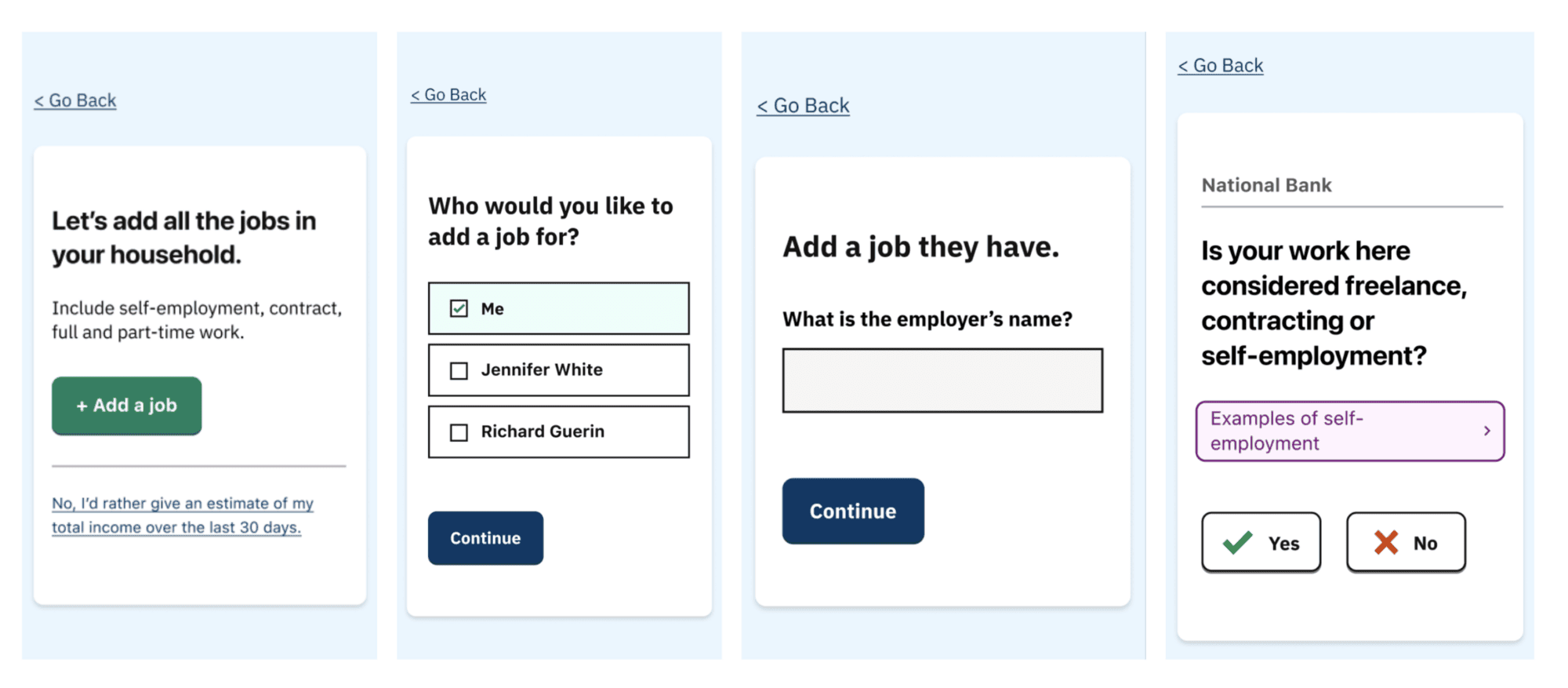
Give applicants the option to report income for each job or other source of income separately, instead of asking for the total household income in the last 30 days. Let them know the types of income that should be reported, then let them provide details about each full- or part-time job or type of self-employment, on its own.
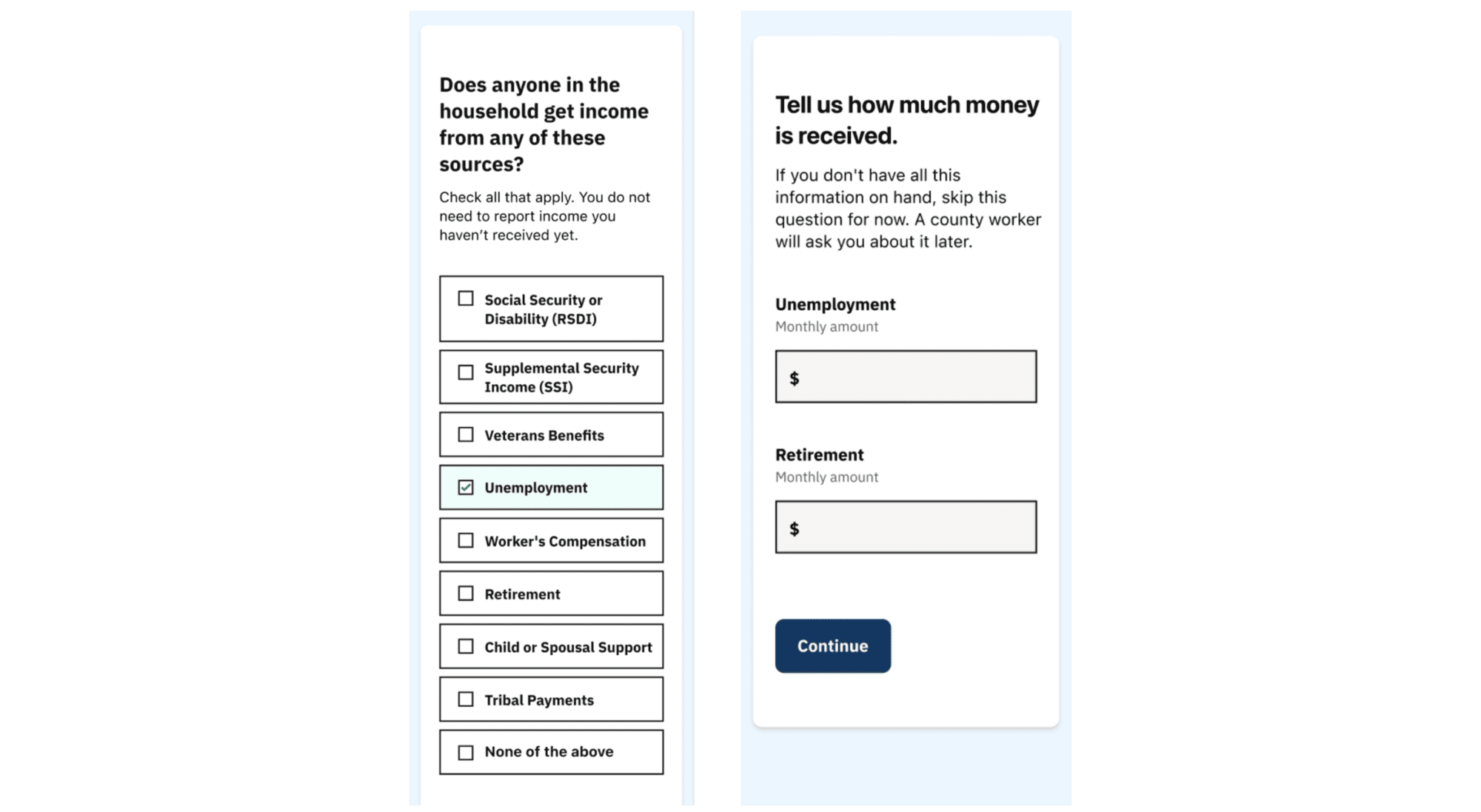
Take the same approach for asking about income that doesn’t come from a job, like Supplemental Security Income, veterans’ benefits, or Unemployment Insurance.
Tip #2: Don’t make applicants do math to report their income
Ask a series of simple questions that applicants can answer with confidence, like hours worked, wage per hour, and pay frequency. Offer the option for applicants to report income directly from their paystubs. Then run the appropriate calculations for them.
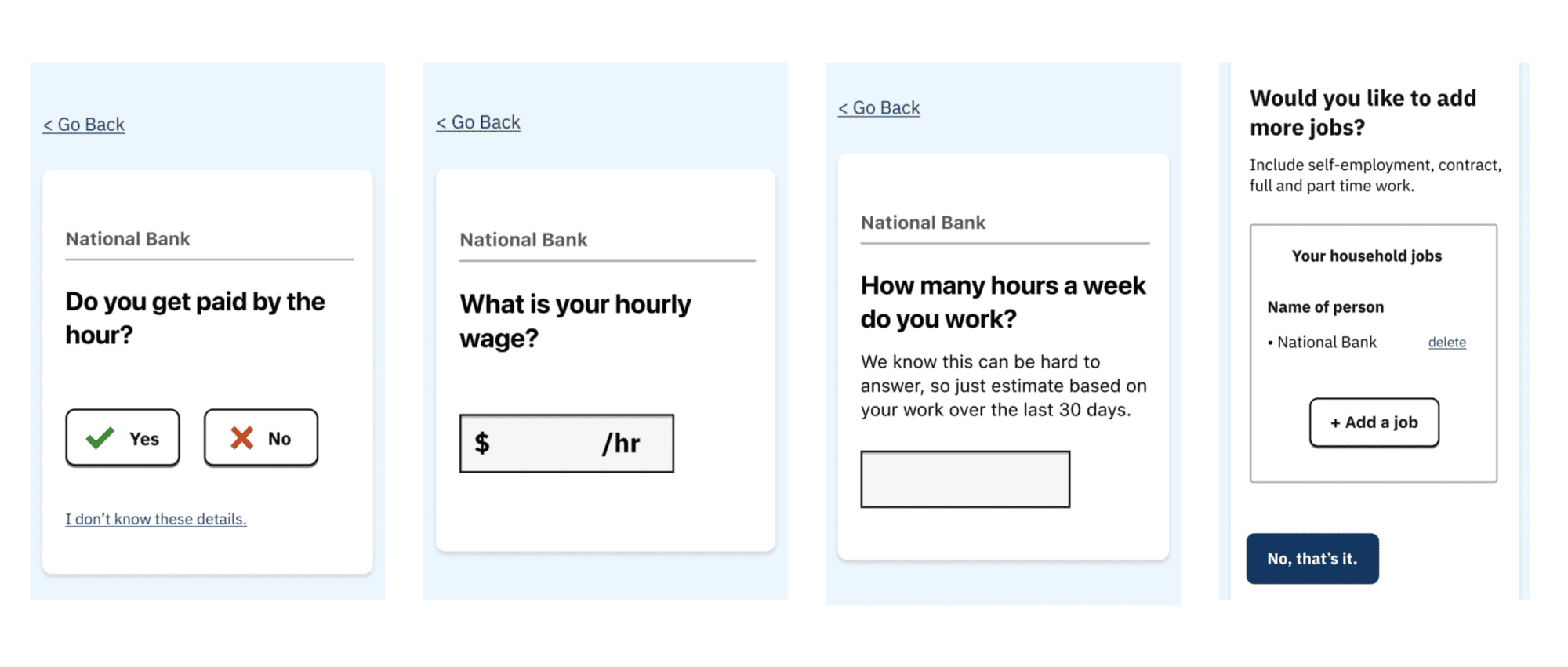
Tip #3: Ask questions that allow for income fluctuation in the past and uncertainty in the future
For instance, if asking how frequently the applicant is paid, one response option could be, “It changes.” Because people often apply after a change in circumstances, you can also ask for the past 30 days of income while offering an option to indicate that that does not reflect the income they anticipate receiving going forward.
Tip #4: Help self-employed applicants report their income
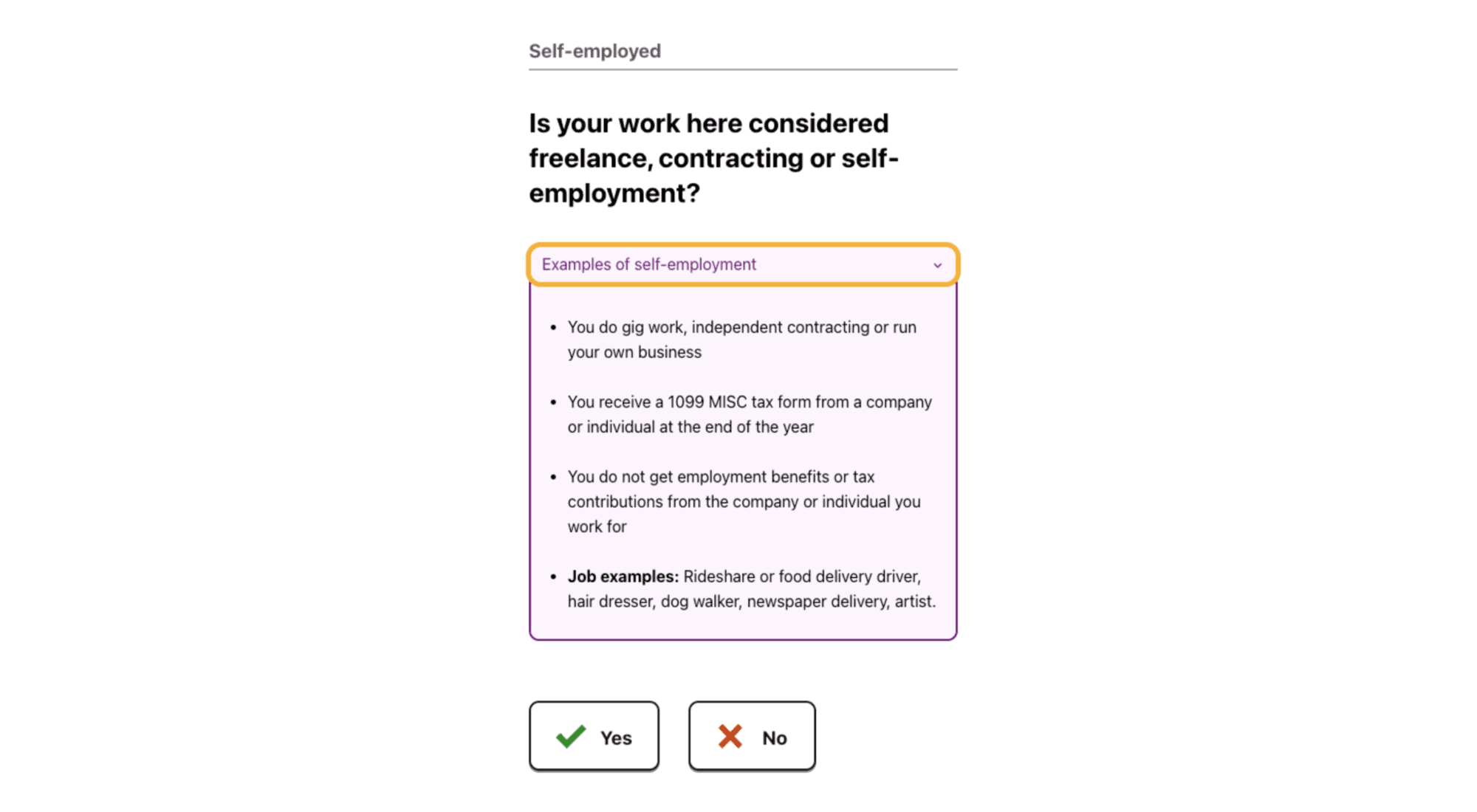
Use other common ways of saying self-employment when asking about it, like gig work, independent contracting, running your own business, side work, and odd jobs. Give examples of the kinds of jobs these are, like driving for a rideshare company, delivering food or groceries, or doing yard work. You can also list some places they might find this information, like Zelle, Venmo, or paychecks.
Asking about household composition
The way that benefits applications ask about household composition matters because, like income, the correct answers help eligibility workers issue accurate benefit allotments. Our research also shows a reduction in application drop-off rates after implementing these recommendations for asking about household composition.
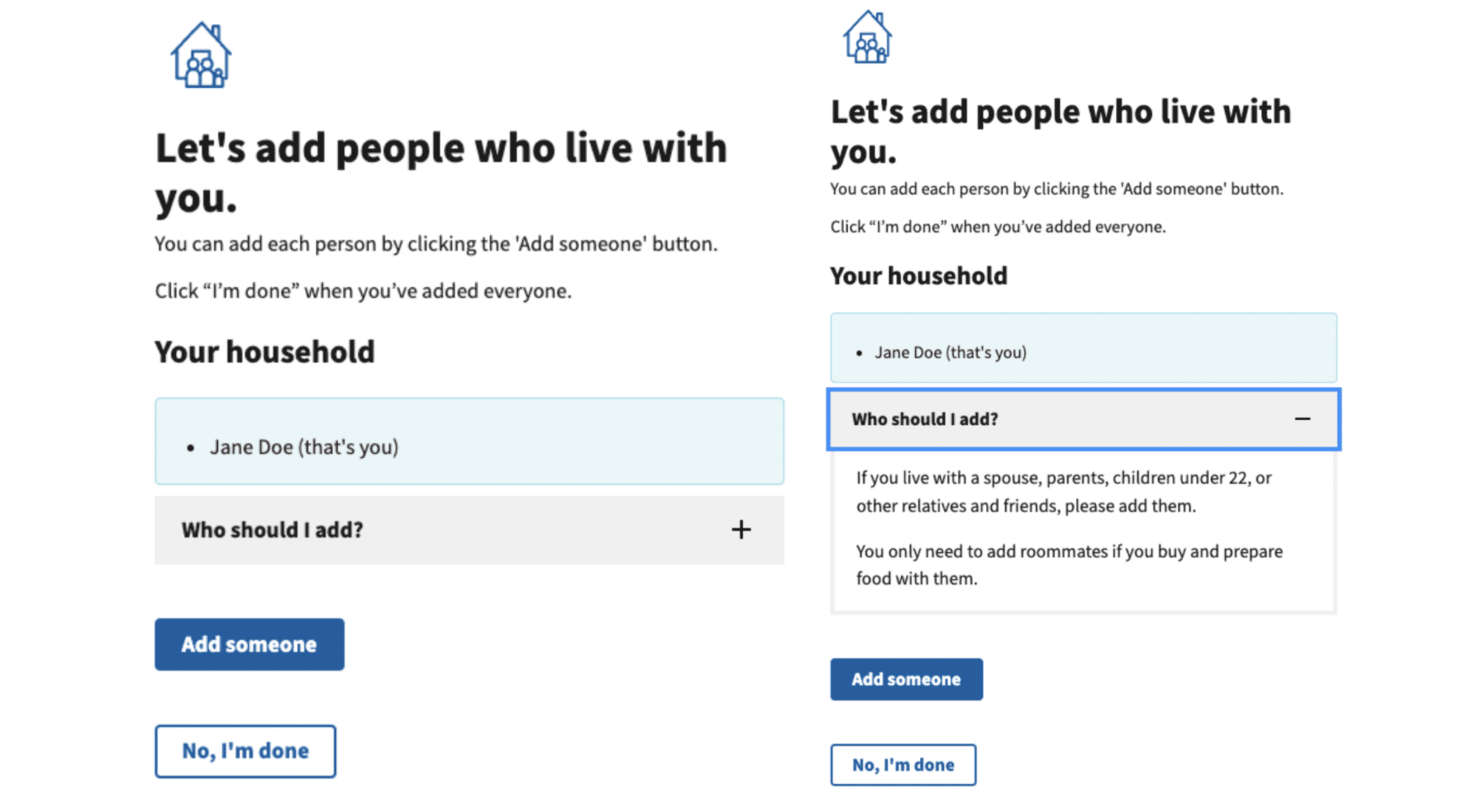
Tip #1: Be specific about who needs to be added to an application as a household member
Offering supporting information as shown in the image below helps Supplemental Nutrition Assistance Program (SNAP) applicants know who needs to be included in their household. A best practice in design called a “reveal” allows applicants to click for more information if their situation is less common, like if the applicant has partial custody of children, shares household expenses with roommates, or lives in a multigenerational household. This allows applicants with more common situations to move through the application easily while still providing comprehensive information for edge cases. If the applicant is also applying for Medicaid, you can ask a similar series of questions that help applicants understand who should be included as part of their tax filing household.
Tip #2: Help clients answer only the questions that are necessary about members of their household
Only show questions that are relevant to the household based on the information the person has already provided in the application. This is called “question gating,” and helps applicants skip questions that are unnecessary for the benefits they or other members of their household want. One way to gate questions is to apply thresholds—for example, if an applicant says someone in their family lives outside the home permanently, they don’t need to answer questions about that person to apply for SNAP. Another way to reduce unnecessary questions is through “skip logic,” where applications show or hide questions using programmed rules. For example, an application may only ask the head of household for contact information, and only ask people over 18 about marital status.
Tip #3: Mark required questions clearly
You can offer clients helpful tips before they start an application, like showing how required questions are indicated, and explaining how non-required information might still need to be gathered in the future. This could mean including text like: “The other questions are optional, but you’ll have to answer them when you talk to an eligibility specialist. That might take more time than filling this out online.” In an integrated benefits application, the questions that are required should change depending on which benefits each household member is applying for.
Building an application that works
Getting clear answers about income and household composition isn’t just a technical challenge—it’s a chance to build trust. When applications use plain language, define what counts, and acknowledge real-life complexity, clients can answer with confidence and dignity. Clear questions reduce errors, speed up determinations, and lighten the load for caseworkers, creating a better experience for everyone involved. By grounding form design in user research and tested best practices, governments can move beyond guesswork toward systems that truly work for people. Small improvements in how we ask questions can make a big difference in access to essential benefits.
Do you want guidance as you build a benefits application? Reach out to hear about our partnership options.