- News and Stories
- Blog post
- Safety Net
A Human-Centered SNAP Work Requirements Screener
H.R. 1 expands work requirements for people who use the Supplemental Nutrition Assistance Program (SNAP), reshaping eligibility for millions of participants. SNAP’s work rules are complicated, and limit people to three months of food assistance every three years when they can’t demonstrate that they are either working at least 20 hours a week or exempt. Many people who should qualify for exemptions because of conditions that limit their ability to work fall through the cracks and lose access to food assistance, either because they don’t know they’re eligible for an exemption, or because they don’t know how to claim the exemptions they are entitled to receive.
By asking simple questions when a client is applying and providing an easy, comprehensive way for clients to share their circumstances, administrators can quickly figure out if a client should be exempt from work requirements.
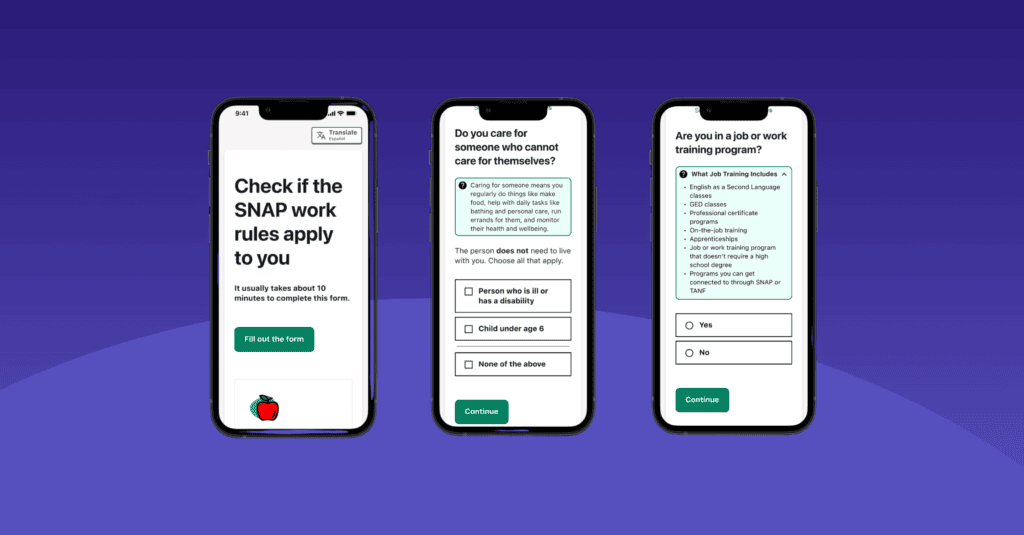
We’ve designed a screening question set that uses plain language and best practices to help clients proactively identify and report to their state agency if they have any exemptions. These designs were tested and refined through user research with SNAP clients and community-based organizations across the country, which helped us refine the wording and framing throughout these questions. As we continue to iterate, we are excited to bring you into our learning journey to share what we have drafted and the insights behind them.
States and counties can incorporate these designs into their existing systems, or use this language as a starting point for asking about exemptions in their forms in ways that resonate with SNAP clients.
Plain language screening questions for SNAP work requirements
State agencies responsible for administering benefits can simplify the work caseworkers do to process benefits applications and renewals by incorporating the right questions into the application or re-certification forms clients fill out. Our question flow helps determine whether or not a client should be deemed exempt from work requirements, making the screening process easier for everyone.
View the SNAP Work Requirements Screener here, or click through this interactive prototype on Figma to visualize how the question flow could appear on an application. You can also download the Screener as a Word document.
Make the intention clear by avoiding policy jargon
One of the most common insights we heard from clients in user testing was that it can be hard to know if their situation meets the criteria for a particular exemption. It is ultimately SNAP eligibility staff who make that determination and the job of a clear form is to help bridge what the policy means and what a client understands it to mean. In testing, we learned that phrases from policy that appeared simple (e.g. “Do you provide care for someone?”) could be confusing. For example, in client interviews we learned that people often didn’t understand what qualified as “care.” In the words of one client: “Is that providing food? I sometimes help my elderly grandma out, does that count?” We helped reduce guessing by defining the exemption using specific examples, called out visually immediately under the question. In this specific example, we also offer an open-text field where clients can describe their situation – giving caseworkers more context to determine whether a client’s life situation meets the criteria in policy for granting an exemption.

Translating phrases from policy into plain language sometimes means replacing phrases altogether, and choosing different words that help make the meaning of the question clearer. For example, some clients also found it hard to understand what counted as being “chronically homeless” — a category that states often use for assessing whether some qualifies for an exemption under “fitness for work” criteria. The spirit of the term is to indicate that the client may not consistently have their basic needs met. We chose different words that made the implications of being “chronically homeless” the focus: “Do not have a regular place to sleep or shower.”
Demonstrate care when asking about challenging situations
SNAP allows time limit exemptions for a variety of difficult life circumstances that can make it infeasible for a person to consistently work 20 hours a week. When we spoke to states on how they define the “unfit for work” exemption in practice, they offered specific examples like “someone fleeing from domestic abuse,” “someone with a debilitating drug or alcohol addiction,” or “someone with a medical condition that prevents them from working.”
Given our many years of experience supporting clients in accessing safety net programs, we know that many people already feel a sense of stigma around needing help. To ask about life situations that would affect someone’s “fitness for work,” we knew it was important to approach these questions with compassion. Previous research showed that clients often felt these questions were private – so we placed the questions in their own section with framing language that helps prepare the client for language about difficult scenarios, and helps them understand why we’re asking about these sensitive topics. This section’s question design offers a list of options in response to a single question, creating a less emotionally intense experience compared to a format where they are asked about every difficult situation one-by-one, page after page. After a client selects any of the “fitness for work” criteria, the next page leads with acknowledgement of the difficulty of their situation, and offers a resource for additional support. States and counties implementing their own work requirement screeners should consider providing location-specific resource referrals.

Designing kindness into your work requirements screening forms isn’t just important for respecting people’s dignity while they are accessing government services, it also helps reduce the burden on caseworkers by giving them critical information about clients’ difficult life situations to guide them in the client’s eligibility interview.
Make the next steps in the process clear
Completing screening questions is just the first step, regardless of whether clients have an exemption or not. States may require additional proof for some types of exemption. In our designs, we include guidance on what kinds of proof to submit only for those exemptions where our research showed us that workers are most likely to ask for additional documentation. While this can continue to be refined as this policy is implemented, our goal was to help set clients’ expectations for what a worker likely needs while reducing the burden of getting documentation that usually isn’t needed. States should customize their guidance about proof based on their own policy and processes.
Clients who do not have an exemption from work requirements need information about what they need to do to meet the requirements, how the agency will request that information, and how to report “good cause” when they can’t meet the requirements in a particular month due to an emergency.
Moving forward
At Code for America we know that continued feedback and user testing is critical to human-centered design, and believe that iteration is essential to developing effective products. In the coming months we’ll continue to build upon this work with a Spanish language version, hone on in question order, focus on creating the best possible experience for clients. We are excited to continue to share learnings and updates.
The administrative burden of work requirement policy is enormous—but there are ways states can reduce the strain on clients and caseworkers. We encourage agencies to make the most of their time and resources by starting with work that already exists. Code for America stands ready as a partner in your efforts learning and iterating toward a human-centered program implementation.
Want to learn more about how to use this screener? Register for our webinar “Screening for SNAP work requirements using human-centered design” happening February 18, 2026.