- News and Stories
- Blog post
- Summit
Government Gains with Colorado’s Family and Medical Leave Insurance program
In our Government Gains series, we’re talking to dedicated public servants to learn three things about a recent project they’ve worked on that shows what’s possible when people ideate, collaborate, and innovate within government.
For this installment, we spoke with Tracy Marshall, the Division Director of Colorado’s Family and Medical Leave Insurance (FAMLI) program. Her team is on a mission to improve the experience of applying for insurance benefits in the state. Recently, FAMLI confronted a statutory mandate to launch premiums collection in 13 months and deliver benefits 12 months later—all while building the organization that would administer the benefits itself. We spoke with her about what made this project challenging—and rewarding.
What was the biggest challenge you faced in this project?
The most defining challenge for us was starting from absolute zero, on a limited timeline. When I say “zero,” I mean it quite literally. I personally was new to public sector work, and didn’t even know state procurement rules when I began. I didn’t know my coworkers; we had no executive team in place, no vendors onboarded, and not even a physical space where we could sit down and figure it out together.
So while we were building the technology platform, we were also hiring a team at the same time. In the early days, we relied heavily on contractors, who were delivering work while also helping us become an organization. But to be sustainable long-term, we knew we had to build a cultural blueprint that could last, too.
So our biggest challenge was building three things from scratch, all at once: a new technology platform, a new service model, and a new operational culture to put into practice.
How did you approach this challenge, and how did you decide which tools to use to solve it?
We accepted early that we couldn’t build everything sequentially, as if we had all the time in the world. Instead our goal became to build a system that could evolve in real time alongside the people and processes supporting it.
On the product side, we embedded an empowered product manager to oversee the development of the technology. And just as importantly, we grounded that development in functional user research. We looked at broadband access, device usage, and technology confidence across Colorado, so the system would work across real-world conditions experienced by our constituency.
We solved for the hiring and team-building challenge by sequencing backward from statutory milestones. What that meant was ensuring that when premiums launched, we already had trained staff ready to support employers, and that by the time benefits launched, we had a staffed and ready contact center to respond at scale. Implementing internal feedback loops between the contact center, product, and policy teams allowed us to continuously refine the experience of the program as we went.
Where will the lessons you learned here be applied in the future?
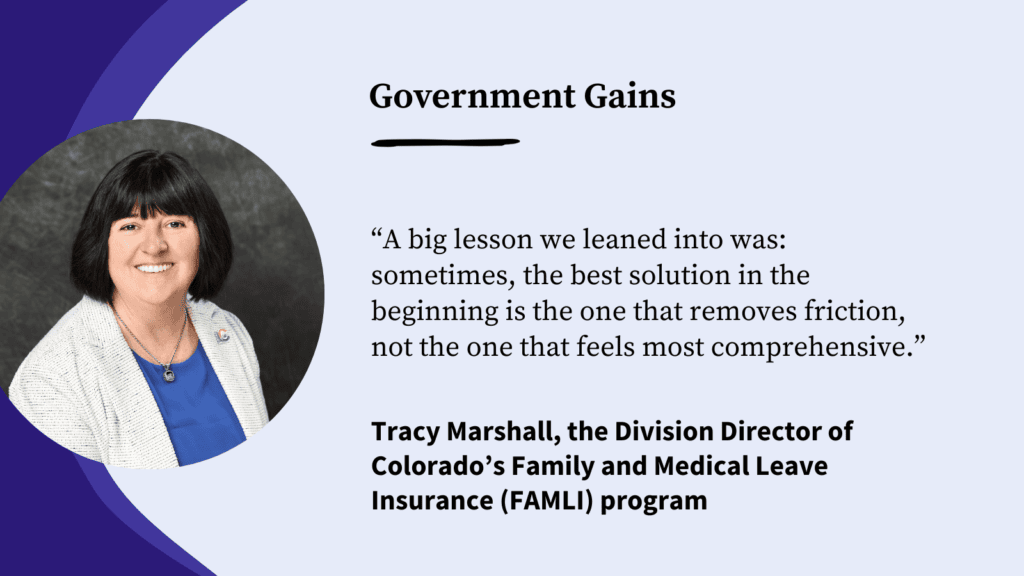
A big lesson we leaned into was: sometimes, the best solution in the beginning is the one that removes friction, not the one that feels most comprehensive.
In several cases, choosing a simpler, faster path, like leveraging an existing telephone system, or selecting a digital tool that could be deployed immediately rather than waiting on procurement, allowed us to keep momentum and meet our statutory obligations without overcomplicating the build.
Another lesson was that sequencing people alongside the product is just as important as sequencing the product itself. Building a team wasn’t a quick ramp; it was really a 12-month process to recruit, onboard, and fully train staff. That reality isn’t something that can accelerate to meet a deadline, and is a lesson we’re always planning for upfront.
And lastly, we really believe building trust in a program at this scale is absolutely crucial. Early user testing was a part of that initially, and now we’re expanding that through an emphasis on fraud prevention, employer satisfaction scores, claimant satisfaction scores, and more.
Want to hear more about FAMLI’s work? Tracy and her team are presenting a breakout session at Code for America Summit, happening May 7-8 in Chicago. Find out more about Summit and get your tickets today.