- News and Stories
- Blog post
- Summit
Leading the Field: Marcie Chin
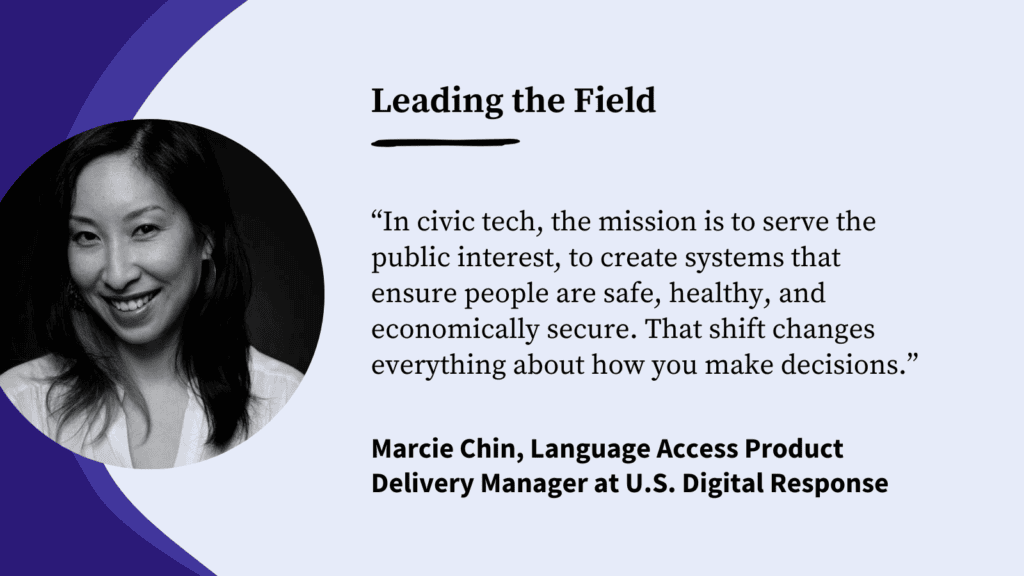
For our “Leading the Field” Q&A series, we’re speaking with leaders in the civic/gov tech space who are driving important change to make government work by the people, for the people, in the digital age. In advance of our upcoming Summit, we’re talking to some of the speakers to hear more about their journeys in civic tech. This week, we spoke with Marcie Chin, a Language Access Product Delivery Manager at U.S. Digital Response. At Code for America, we welcome a broad diversity of viewpoints—and we strive to let people speak in their own words about their own unique experiences. With that in mind, the following has received only minor edits for length and clarity, and the views expressed here reflect those of the author.
Can you tell us a little about what first drew you into working in civic tech?
For most of my career, I followed my interests wherever they led—from academia and community organizing, to product management in the consumer tech space. But despite genuinely enjoying the work, I felt a growing unease that the skills I’d built weren’t connected to the problems I cared most about.
I volunteered with U.S. Digital Response (USDR) during the pandemic, spending most of 2020 using my product management skills helping states meet a surge of unemployment insurance claims not seen since the Great Depression. It was like a light bulb went off in my brain. I had never encountered civic tech as a field or a community before, and suddenly I experienced alignment between my skills, my values, and a viable career path. In hindsight, it felt inevitable. Both of my parents are retired public servants, and being raised in a household where public service was just what you did made this work feel personal to me.
When the opportunity came up for me to join USDR full-time, I jumped at the chance. Five years later, I’m grateful to not only still do this work, but to provide opportunities for other volunteers to find their path to civic tech.
How does forefronting language access impact the way you think about product and service delivery?
It fundamentally changes what you’re optimizing for. In private industry, the mission is profit generation and increasing shareholder value. In civic tech, the mission is to serve the public interest, to create systems that ensure people are safe, healthy, and economically secure. That shift changes everything about how you make decisions.
There’s a concept in inclusive design called the curb cut effect, which is the idea that what’s built for the most underserved users ends up benefiting everyone. Language access works the same way. When you design government services that center the needs of people who have historically been left out, you end up with clearer, more accessible services for everyone.
Language is a core design feature. If you treat it as an afterthought, you’re building exclusion into the product from the start. I think of language access as an opportunity to reflect the lived experiences of the people you’re serving in the service itself. When people can relate to the content, they subconsciously understand they are in the right place. They belong. That feeling matters because the reason people need these services is usually because they’re already going through something incredibly stressful. Feeling seen and treated with dignity can both ease that and build trust.
As AI’s role grows in civic and government tech, are there any places you’re seeing it applied that are particularly exciting?
What excites me most is building human-centered and worker-centered solutions that use AI to solve problems that previously weren’t possible to solve at scale. Language access is the clearest example. Legal mandates requiring governments to serve people in their primary language have existed for decades, but most agencies have never had the resources or tools to meaningfully comply with them. USDR is using generative AI to transform that, not by replacing the human expertise that quality language access requires, but by empowering those language experts with better tools that expand their capacity to serve more people more effectively. What we’ve built shows that LLMs can provide a real pathway to standardize and scale multilingual communication across government, guided directly by the staff who know the language, the community, and the context best.
Our methodology also creates both the incentive and the mechanism to finally adopt best practices that equity advocates and public interest technologists have been pushing for decades. This includes building partnerships with community-based organizations as part of a feedback loop that validates translations, surfaces community language needs, and builds the kind of trust between government and the public that has historically been really hard to earn.
Has there been a project that’s really challenged you lately?
Every language access project we take on is uniquely challenging. There’s no one-size-fits-all approach and that’s part of what keeps this work so engaging. Most of the problems that come to us are shared across nearly every public-facing government agency, but very few have been approached with a service design lens. We’re often working in a space where policy and administration simply haven’t caught up to what technology now makes possible. Bridging that gap is as much about change management as it is about building the right product.
One tension that’s consistent across all our projects is figuring out the right solution at the right moment. The technology is moving so fast that what made sense six months ago might not be the best approach today. Our partners trust us to set them up for long-term success—not hand them something that becomes a liability later. That tension doesn’t go away. You have to embrace it, which means staying curious, building repeatable frameworks while resisting the temptation to reuse solutions just because they worked before, and always keeping one eye on where the technology is heading.
You’re presenting in the Demo Lab at Summit this year about your AI-powered translation work to improve benefits access. How does your demo speak to the theme “the future we build”?
The future I want to build is one where multilingual communication is the default. To me, that means treating language access not as a separate practice, but as an intrinsic part of how governments approach plain language and, more broadly, accessibility.
What our demo shows is that plain language is the foundation that makes good translation possible. There’s a tremendous amount governments can do to build that foundation with tools they already have. You don’t need to go through complicated procurement processes or allocate budget to custom tools that could be better spent hiring in-house bilingual staff and investing in user research. You need the right framework, the right guardrails, and people who understand both the technology and the communities it’s meant to serve. That’s what we’re building and handing off. The future we’re building isn’t one where USDR is always in the room. It’s one where governments have the knowledge and confidence to do this work themselves.
Want to hear more about Marcie’s work? She’s presenting in the Demo Lab at Code for America Summit, happening May 7-8 in Chicago. Find out more about Summit and get your tickets today.